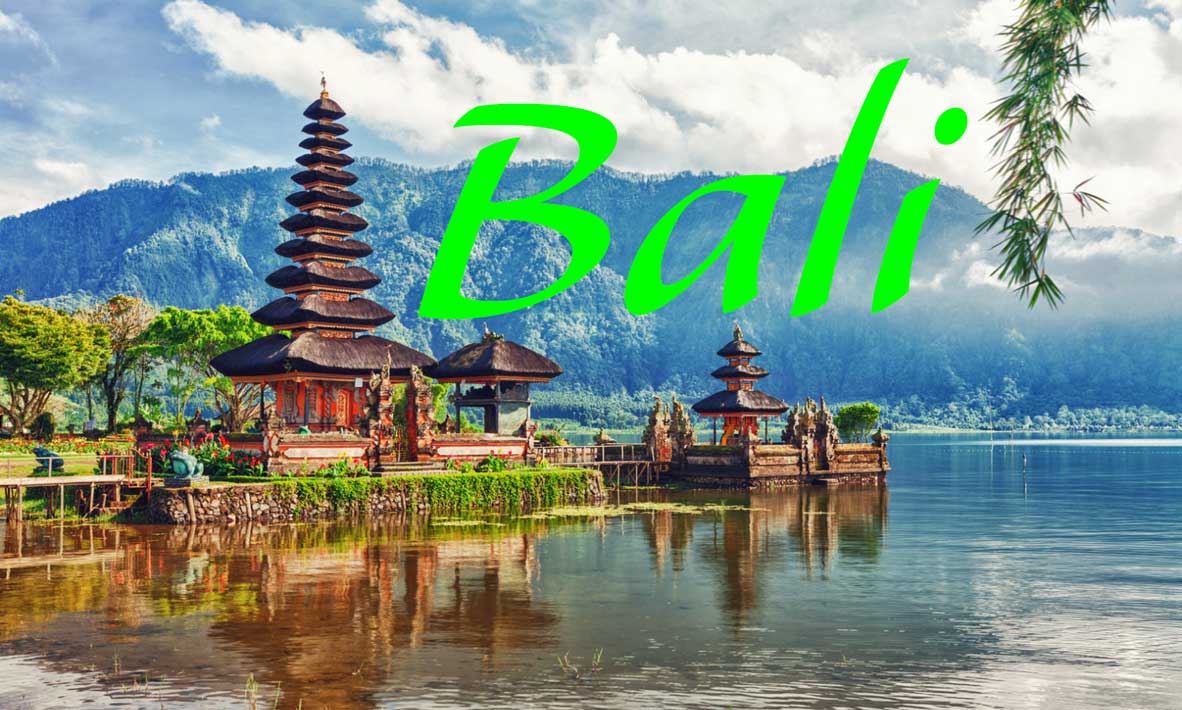
Bali... Island of the Gods
There
was a time when the whole of South East Asia was totally Hindu. The
first inroads into this idyllic society was made by Buddhism which did
not totally disrupt the ideals of Hinduism. Next came Islam with its
militant determination to convert the whole world. The peace loving
Buddhists and Hindus were an easy prey. They were incapable of combating
such a deluge. It is a miracle that the island of Bali weathered this
onslaught. The very word Bali conjures up a vision of an enchanted
island, a gem set in the middle of an emerald ocean totally isolated
from the rest of the world. Today it is the only place where Hinduism is
a living culture. Hinduism in India has been constantly shaped and
molded into various shapes due to the constant foreign attacks, but
somehow this little pocket of green known as Bali seemed to have escaped
the Islamic onslaughts and retained its original culture. No doubt much
of it has been tainted with Buddhist practices since Buddhism had been
gently pushed out of India and had found a foothold in all of South East
Asia.
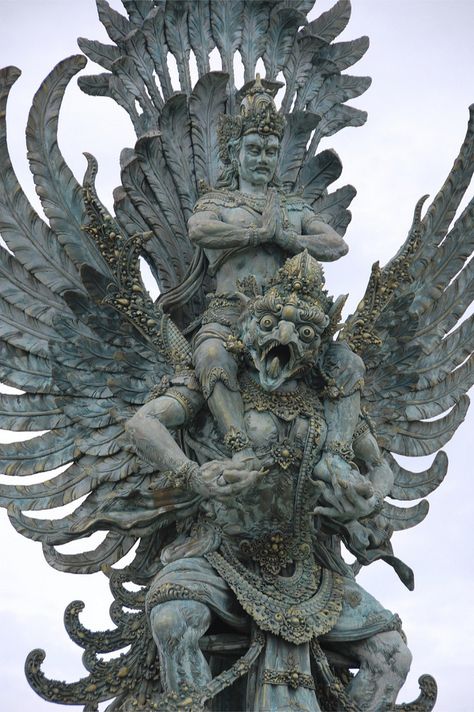
Lord Vishnu on Garuda Eagle
In ancient Bali, nine Hindu sects existed, namely Pasupata, Bhairawa,
Siwa Shidanta, Waisnawa, Bodha, Brahma, Resi, Sora and Ganapatya. This
is a division which had been made by Adi Shankara and still exists both
in India and in Bali. Each sect has its own specific deity as their
names imply. Even today you find temples to all these deities but unlike
the temples of India, there are no figures inside the shrine. One of
the few figures you find is of Ganesha and sometimes of Vishnu astride
the Garuda. Most of the figures of Ganesha look quite ferocious but
Vishnu generally has a pleasant expression. Many horrific figures of
Krishna slaying Putana and Arjuna holding the bow are to be seen in the
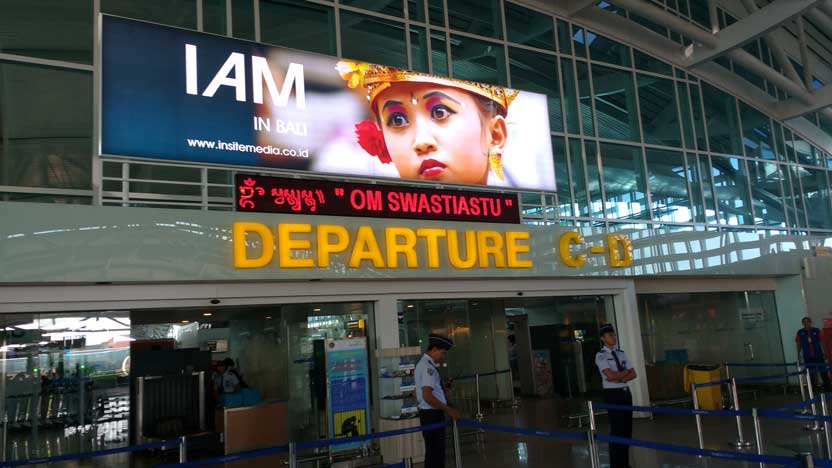
airport as soon as you step out of the entrance. In fact the big lighted
board showing “I am in Bali” has this Sanskrit sloka written under
it. “Aum Swastiastu.” I was really so happy to see this but sad
that nowhere in India either in the airport or anywhere else do we find
Sanskrit slokas or statues of gods in public places.
Of course I was anxious to find out the differences in the way Hinduism
was practiced in Bali and in India. The most noticeable difference lay
in the fact that there are no idols or priests and no elaborate rituals
as we have in modern India. Another important fact is that a lot of
Tantric practices have crept into Bali, like the offering of meat and
fish and even liquor at the temples. Of course this roused my
curiosity. Peering into the past I realized that the Hindus who had
originally come to settle here had been merchants and traders and even
brigands and pirates of the seas. They came in their little trading
boats and eventually settled down on this island which must have seemed a
good place to settle, rather that brave the seas and go all the way
back. This meant that no Brahmins had come to Bali. Of course the
Brahmins were the custodians of the Vedas and thus the knowers of the
rituals etc. So these ancient settlers must have started practicing some
form of Hinduism with only a very vague idea of its basics and what we
see today is the outcome of their efforts.
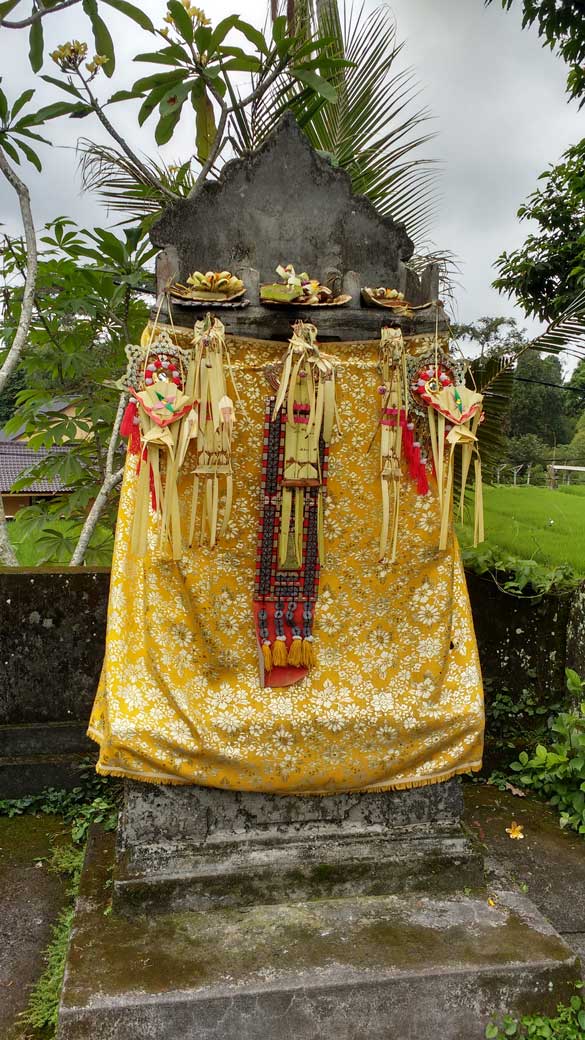
Shrine with offerings in paddy field
Hinduism is a religion with
infinite scope for individual differences so no doubt these
practices however diluted they are from the original, still pass
off as Hinduism. The merchants who had come must have realized that they
would have to start farming if they wanted to eat and thus started
cultivating rice and even developed a complex irrigation system to grow
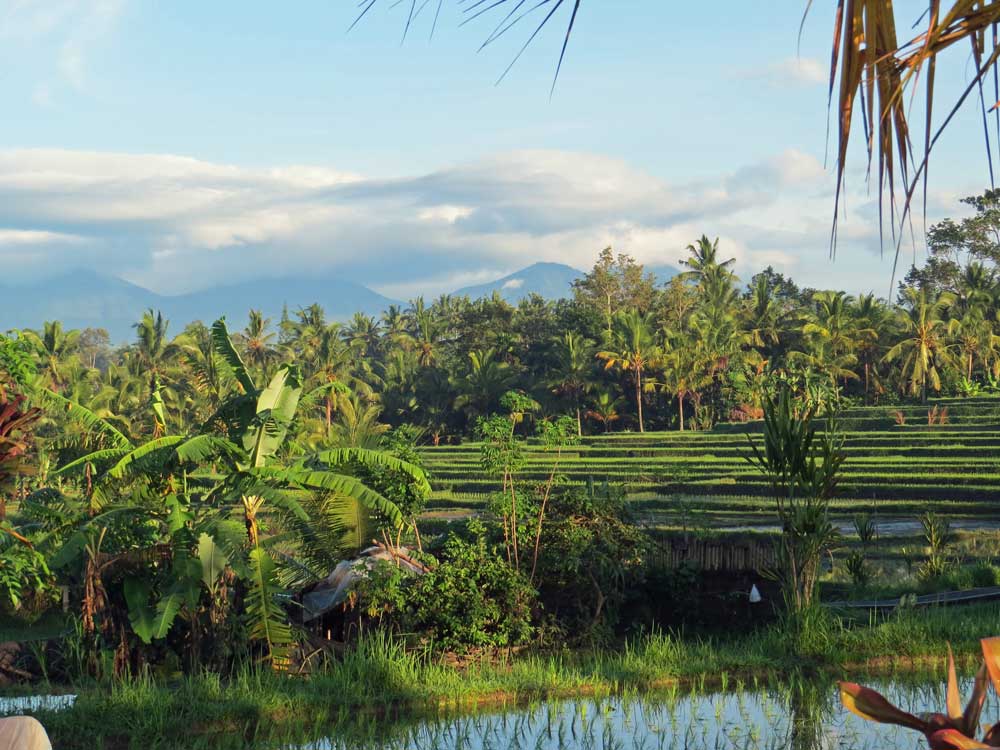
rice in wet paddy fields. These fields are still a joy to behold. A
small shrine is always kept in the middle of the field to guard it from
spirits and of course birds, when the harvest is ready. There is a
guardian deity for every field. I was struck by this sweet idea which
exemplifies the basic Hindu concern for Nature and an understanding that
the whole world is imbued with just one spirit.
Another important difference between Balinese and Indian Hinduism is
that in the year 1960 there was a great revolt between those who
supported the traditional caste system and those who rejected it.
Luckily for Bali the latter group won and Bali no longer follows the
ancient caste system. How I wish India would also be able to follow suit
and do away with the caste system which is the bane of our lives.
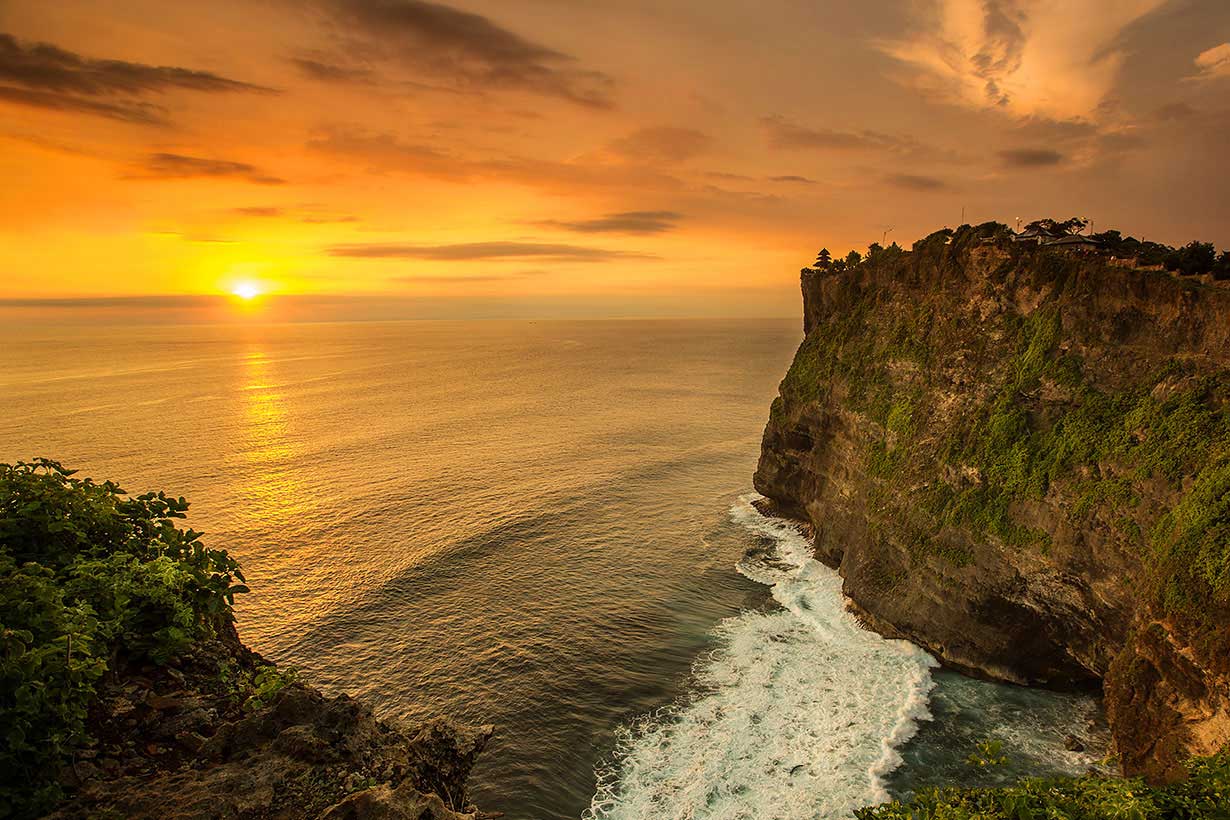
Uluwatu Temple
We
had taken a villa in Bandung, near the Uluwatu temple which is the
second largest in Bali. It is a sea temple (pura segara) and is
dedicated to Sang Hyang Widhi Wasa in his manifestation as Rudra (the
fierce form of Shiva). Strangely enough all the Hindu gods are displayed
in their fierce forms in Bali. Temple is “pura” in Balinese and this
temple is built on the edge “ulu”of a 70 meter high cliff “watu”
projecting into the sea. The cliff is said to be the petrified boat of
the goddess Danu. Apparently the original temple was modified and
expanded by the Javanese sage, Empu Kuturan in the 11th century. Another
sage constructed the Padmasana shrines and he is said to have attained
“moksha” or liberation here. This is known as “ngeluhur” “to go up”.
Because of this the temple is commonly known as “luhur”.
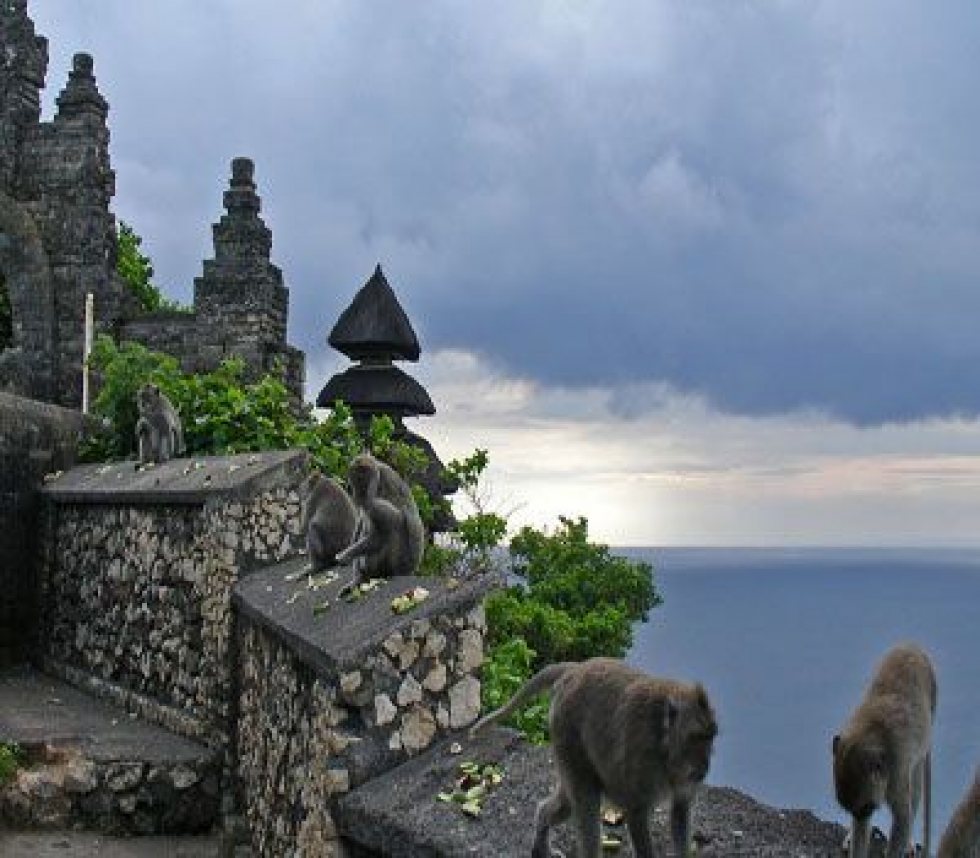 Macaques at Uluwatu Temple
We had gone to the temple once in the morning and again in the evening,
at sunset time. Both times were memorable. The temple is situated in a
huge complex. Before entering, everyone has to drape themselves in a
silk scarf. Most western tourists are very casually dressed and perhaps
that is the reason why they are asked to cover their western clothes
with this scrap of material. However I was fully clad as I usually am
and had a shawl to boot but even then I was not allowed to enter. No one
was allowed to enter the temple unless they wore a typical Balinese
sarong or long cloth which was draped round the waist. My poor
grand-daughter who had already read about this had specially worn a
Balinese sarong but even she was refused entrance since her top did not
have full sleeves! I felt that the man at the gate was really being too
strict. Perhaps he felt that if he showed leniency to one person he
would have to give the same benefit to everyone else. However we could
peek in through the gates on all four sides. There were no idols, only
some small structures and no sign of any priest. Apparently if you
wanted any ritual to be done you had to give previous notice to the
priest who would come and give some instructions.
One of the most important concepts that Balinese ceremonies have in
common with Hindu festivals is the concept of desa and kala which refers
to how a festival or ritual should fit both the place and time context -
the specific and the general context. Many of the ceremonial art forms
such as wayang kulit and topeng are highly improvisatory, providing
flexibility for the performer to adapt the performance to the current
political situation thus making it more interesting to the spectators.
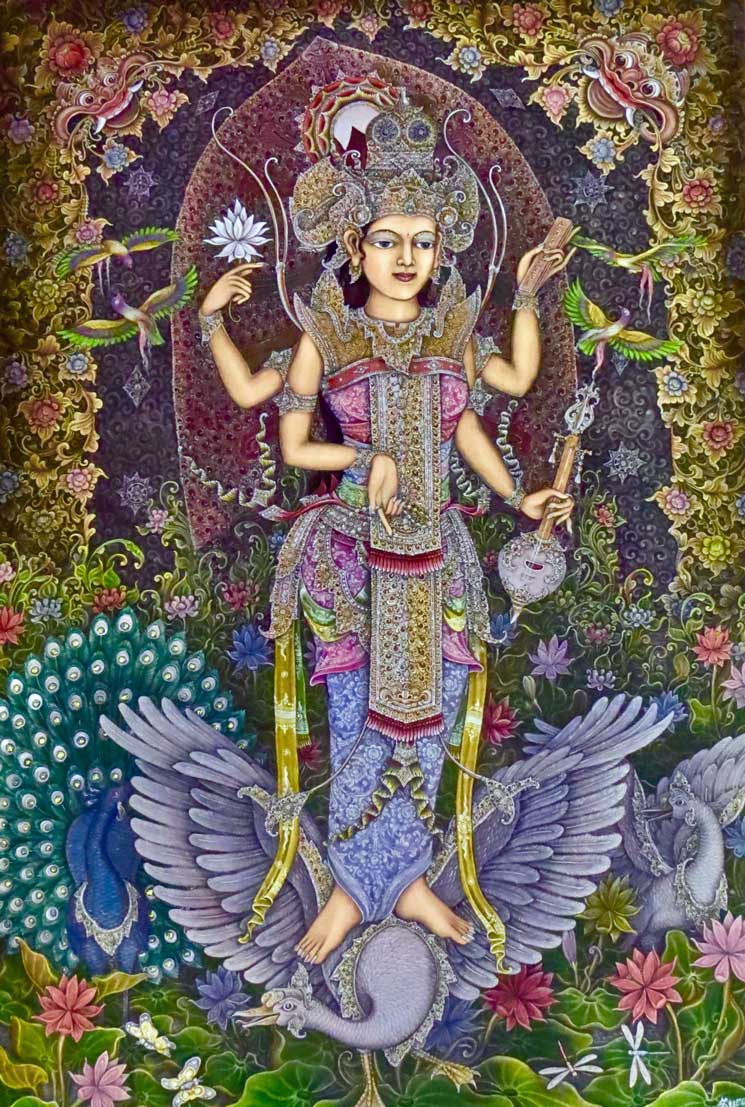 Goddess Saraswati
Balinese performing arts often portray stories from Hindu epics such as
the Ramayana but with heavy Balinese influence. We went to one such
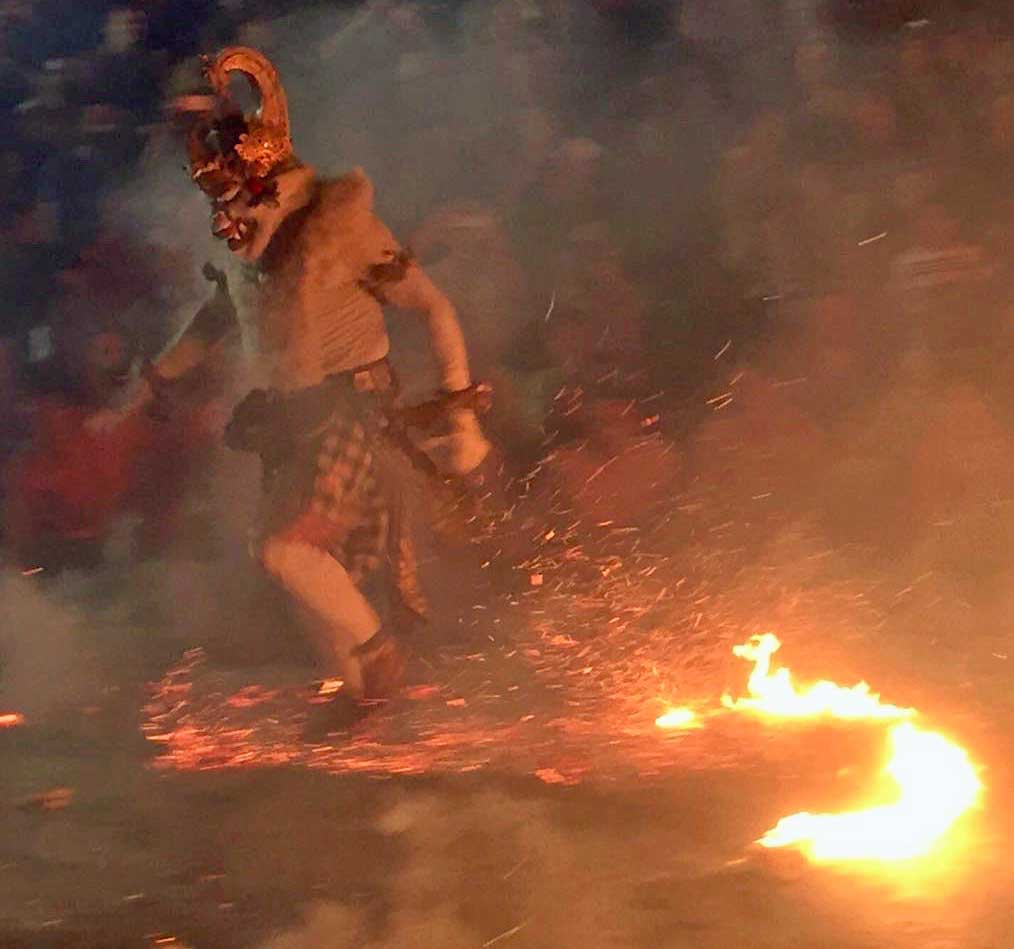
dance called the Kechak Fire Dance which took place most evenings in the
Uluwata temple which we had visited in the morning.
Of
course the most striking thing about the temple was that it overlooked
the sea. In fact as I said in the beginning it was perched on a cliff
hanging over the sea with the waves beating on the rocks below. Since it
was facing the west the setting sun was a marvelous drama which we
participated in when we went to watch the Kechak and Fire Dance which
always took place at the end of the day with the awe inspiring view of
the sea as a background. We went on the full moon day of the Sanskrit
month of Chaitra which is the birthday of Hanuman so the full moon was
rising in the east on one side while the sun set in a burst of crimson
in the west. It was quite an unforgettable scene.
Most temples
have an inner courtyard and an outer courtyard which are used for dance
and drama performances. Balinese rituals are accompanied by a
combination of music, dance and drama. The performances that take place
in the inner courtyard are classified as wali, which are sacred rituals
offered exclusively for the gods. The outer courtyard is where bebali
ceremonies are held, and these are meant both for gods and people.
Performances meant solely for the entertainment of human beings are held
outside the walls of the temple and are called bali-balihan. This
three-tiered system of classification was made to protect the sanctity
of the oldest and most sacred Balinese rituals and prevent them from
being performed for a paying audience.
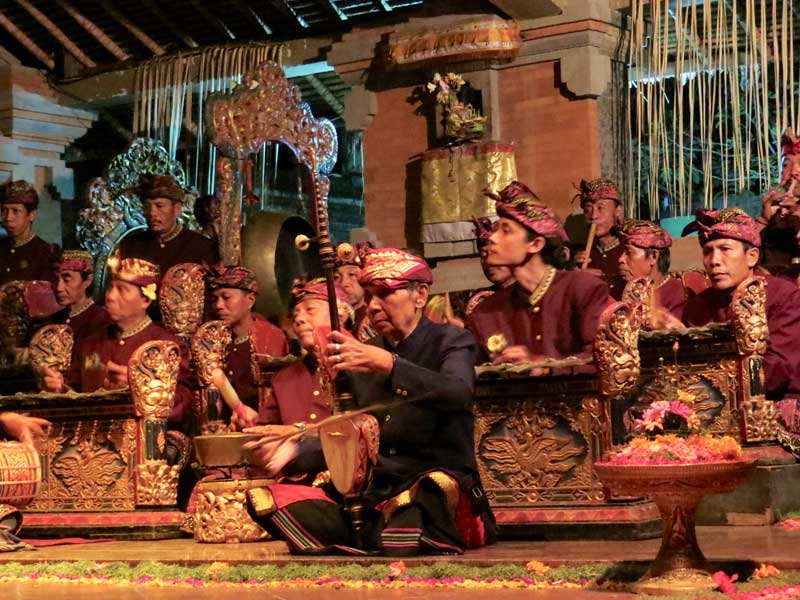
Gamelan Orchestra
Balinese percussion orchestra music, known as gamelan, is highly
developed and varied. This dance is unique since it did not make use of
the usual “gamelan” orchestra which normally accompanies every dance
drama. Instead the so called music was made by a choir of seventy men
who made the typical “chk chk” noises with their tongues. This goes on
relentlessly for over an hour. You can imagine the strength of their
vocal chords. This drama has its origin in an ancient “trance dance”
called Sanghyang. In those days one of the dancers went into a trance
and communicated with deities and ancestors who answered their questions
and conveyed their wishes. The modern Kechak is actually based on the
famous Hindu epic known as the Ramayana. The story of Rama had obviously
made a great impact on the minds of all people over the whole of South
East Asia. We find it being re-told in various forms in Thailand,
Myanmar and Indonesia.
Ramayana
To the mesmerizing tchk tchk noises of the “orchestra” we watched the
ancient legend being replayed- how Ravana, the wicked King of Lanka
kidnapped Rama’s wife, Sita and took her to his stronghold in Lanka.
With the help of the great monkey Hanuman , Rama went to Lanka and
killed Ravana and rescued his wife. Ramayana is the story of great love
and sacrifice. It portrays the many faces of love – the love of a son
for his father and mother, the love between brothers, the love for a
wife and the love between friends. This is why it has stood the test of
time and still gives great joy to those who read it or watch it being
enacted.
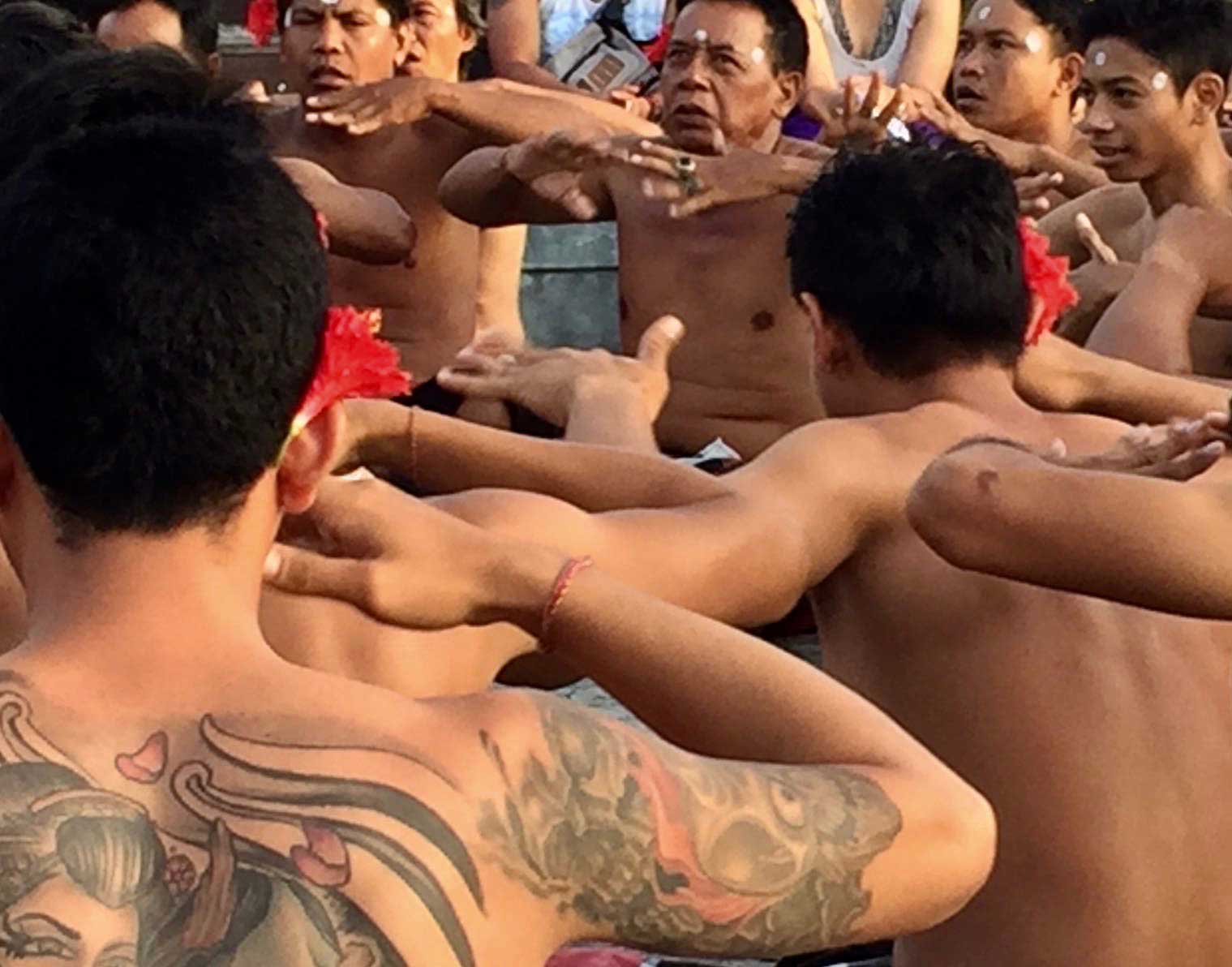
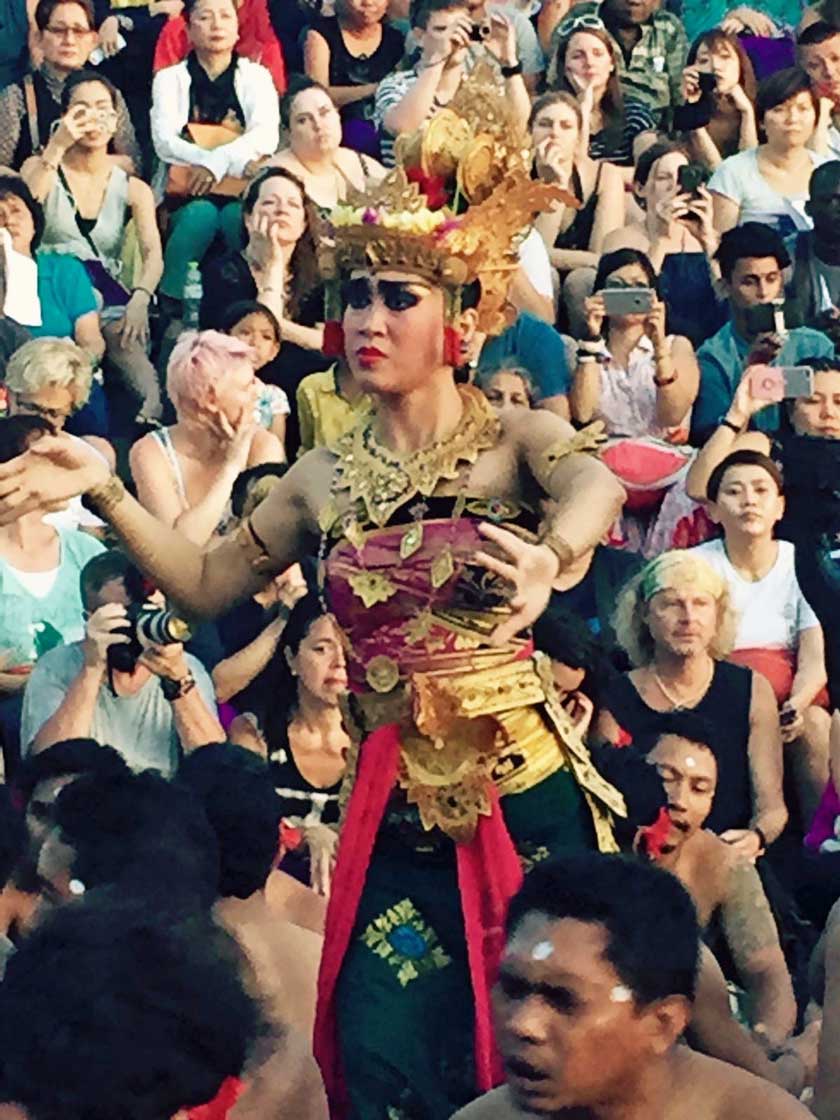
The dance started at about 5.30 pm when the sun was slowly slipping into
the arms of the sea. It was an open- air ampitheatre in the temple
compound with tiered concrete seats. We had just about managed to get
some good seats when a troupe of seventy-five male dancers in Balinese
costume came on to the scene shaking their hands up in the air and
chanting the fast paced “chk, chk” sounds. All of them wore nothing
above their sarong and all had a bright red hibiscus flower in their
right ear. For some time this bizarre orchestra held the stage as
they went round and round with their arms thrown round each others’
shoulders, sometimes squatting and sometimes standing maneuvering
themselves into certain specific patterns. They had their backs to the
audience and faces towards the center and thus made a sort of bastion
with space in the center.
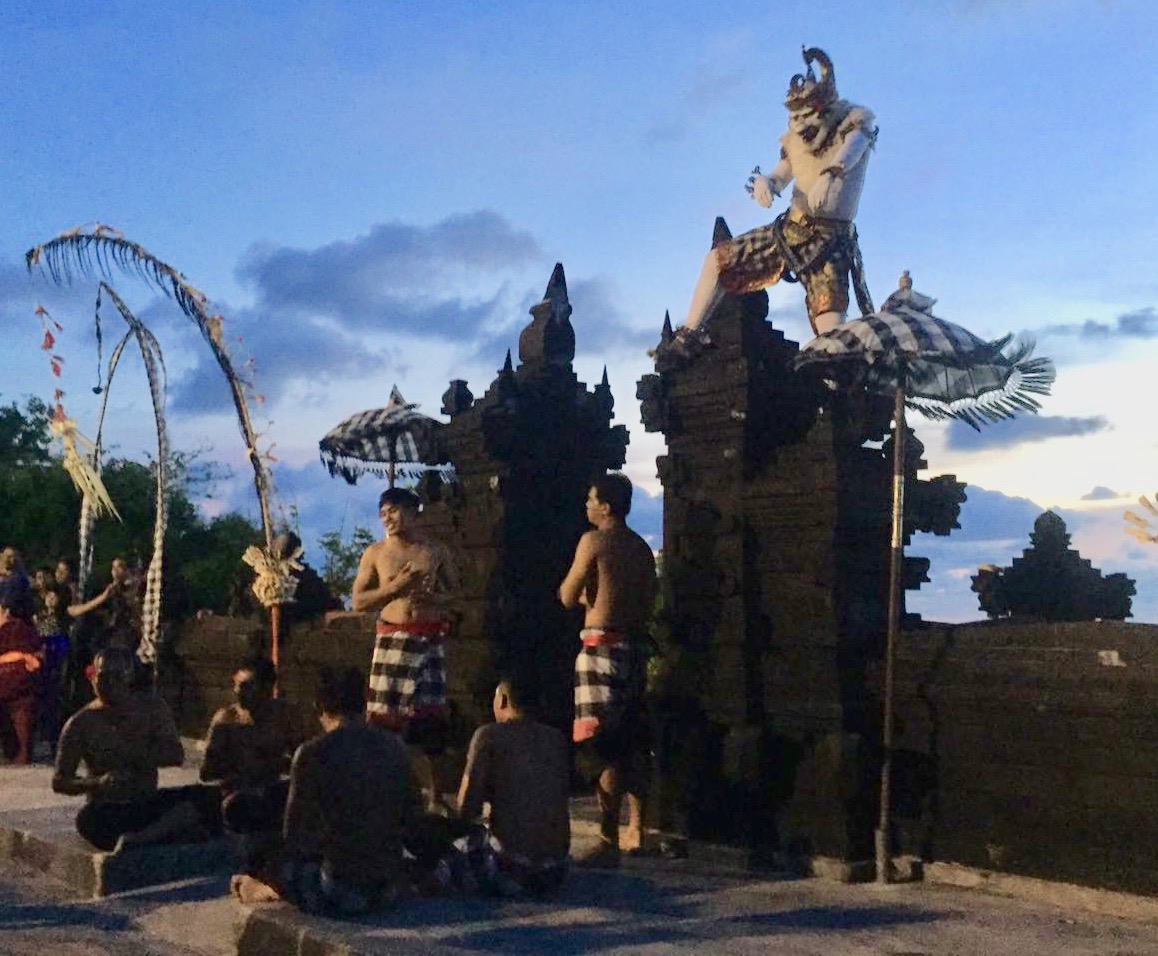
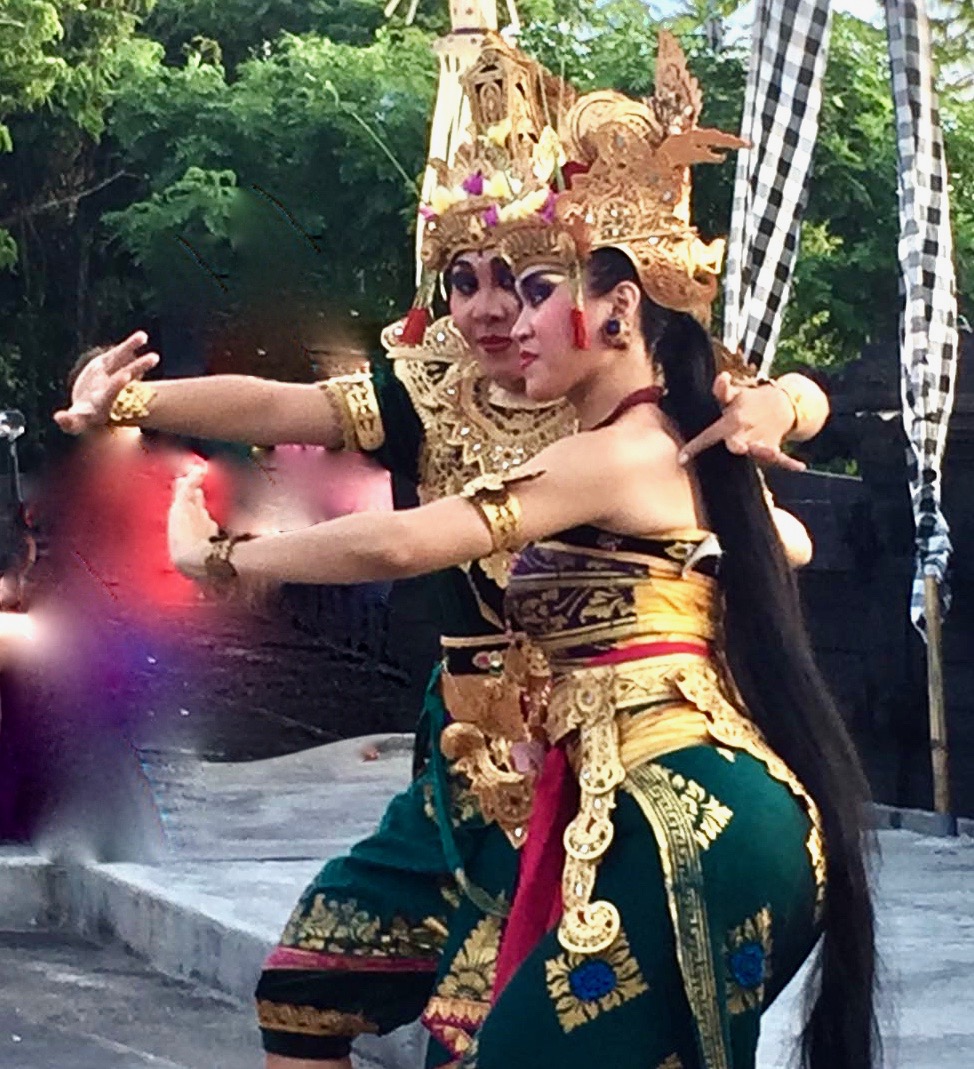
Suddenly Rama and Sita appeared and took their
places in the centre. Rama’s brother, Lakshmana was also there. Then
came the golden deer which was actually a demon in disguise. Sita begged
Rama to get it for her and he left reluctantly with strict instructions
to Lakshmana never to leave Sita alone. Rama obviously killed the deer
but as it died, it imitated Rama’s voice. This threw Sita into a panic
and she orders Lakshmana to go and save him. He is reluctant to go but
at last he is persuaded and draws a magic circle round her and tells her
never to go out of it.
All this time the human orchestra is surrounding
the actors and making appropriate noises depending on the scene which
is being enacted, sometimes clucking furiously fast and sometimes slow.
Ravana the wicked king of Lanka or Alanka Pura as it is called in
Balinese, now comes in the form of a mendicant yogi and begs Sita to
give him food. Unsuspectingly she comes out of the circle and offers it
to him. He immediately grabs her by the hand and drags her away. The
eagle, Jatayu now tries to stop him and is killed by him.
In the next scene Rama and Lakshmana return and Rama is bereft at seeing
the empty ashram. They search for her and meet Hanuman, the white
monkey, in the forest. Rama gives his ring to him and asks him to find
Sita.
The next scene is in the garden of Alanka Pura where Sita sits and
bemoans her fate to Trijata who is supposed to be Ravana’s niece.
Hanuman now appears and gives her Rama’s ring. She is very happy and
gives her hair ornament to be given to Rama. She begs Hanuman to ask
Rama to come and rescue her. Before he leaves Hanuman destroys the park.
Ravana’s servants rush in and bind him and set fire to his tail.
Hanuman jumps round with flaming tail, setting fire to the whole of
Lanka.
It was quite a scene to watch the fire surrounded by the “chk chk,”
chorus. It was quite a big conflagration. But the people were in control
and got it down to manageable proportions. Hanuman now freed himself
and addressed the audience. The all male orchestra now slowly made its
way out in the same manner as they had come in. Hanuman now decided to
play with the audience. He jumped up the aisle and pulled some of the
audience into the arena and asked questions and generally made himself
interesting. Obviously these things were additions to amuse the audience
and were not part of the original script.
Island of the Gods
With an estimated twenty-thousand puras (temples) and shrines, Bali is
known as the "Island of a Thousand Puras", or "Island of the Gods".
The calendar in Bali is filled with all sorts of festivals. One of the
most bizarre which I had seen on my first visit was the cremation.
Apparently most people are too poor to cremate a person separately so
these bodies are kept in the grave until the end of the year when an
auspicious date is chosen. Then all the bodies are piled up on a chariot
like structure and the whole thing is set on fire. It’s quite a
spectacular sight and one which I had never forgotten.
Unfortunately we hardly had time to visit any of the temples for which
Bali is famous. However one day I went on my own to Ubud to visit an old
friend called Indra who was a disciple of the famous lady known as Ibu
Gedong who was a Gandhian and had won an International peace prize. I
had been to her ashram known as the Gandhi Ashram when she was alive.
Her disciple Indra had started an ashram on his own and I made a visit.
It was a charming place set on a small slope. They taught yoga and
followed the Gandhian principles of food etc.
Tana Lot Temple
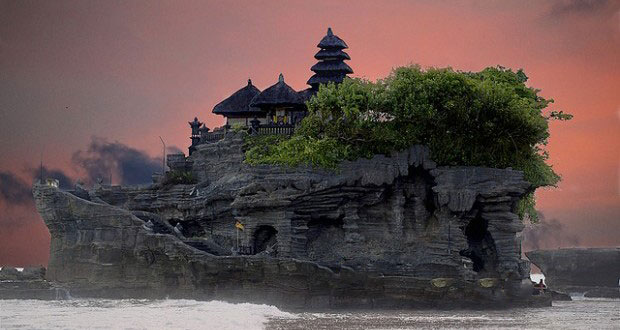
From there the driver took me to a lovely temple right next to the
ocean. The grounds were littered with plastics and paper since they had
just finished the celebrations connected with the full moon. We went
along the beach and I was fascinated to see that the sand was pitch
black. I thought it might be dirt but was told that this was the
peculiarity of this beach. It was one of the few black beaches in Bali
which they were trying to promote. I suddenly noticed that many women
seemed to be picking pebbles from the beach. On inquiring about this I
was told that this beach was filled with shiny black pebbles which were a
rage with many house designers. The pebbles were used on paths and on
walls and many other things. I collected a few and was thrilled to see
how black and shiny they were. I realized that this must be the famous
temple of Tanah Lot. When we went to the gate of the temple the driver
told me sadly that I wouldn’t be allowed inside but I decided to try.
There was an old man sitting inside watching my movements with keen
interest. Two ladies were busy cleaning up the compound which had been
badly littered. I peeped in and asked the man if I could come in and he
beckoned me to come. I was so happy. I ran in and they thrust a small
basket of flowers into my hand. One of the ladies who was brandishing a
broomstick in one hand signed to me to go and sit in front of the main
temple which was set on an elevated platform. I gathered that it was
another Shiva temple, with Brahma and Vishnu thrown in for good measure.
Anyway I was so pleased to have been let in and even allowed to do a
puja on m own that I didn’t want to waste time in asking about their
belief system. I did my own little puja and I was surprised that the old
man who I had taken to be a priest of some sort refused to accept a
dakshina (monetary offering). In fact the sweeper lady who had given me
the basket also refused to take any money. This is a great thing in this
country. There is very little corruption and hardly any petty thievery.
How I wished I could say the same about India. In fact it was a source
of wonder to all of us how the villa in which we stayed was never locked
at night. They just closed the doors and that was it. No one bothered
to go round and lock the doors. My son had rented a car from a lady and
another unbelievable thing was that when we left the country, he asked
her to come to the airport to collect her car and she told him very
sweetly that he could leave it in the parking lot and keep the key under
the foot mat on the driver’s side. Of course he couldn’t believe this
and kept on clarifying these instructions with her. In the end this is
exactly what he did! When we see the number of thefts and deceits which
are practiced in most of the other Asian countries, you will realize the
greatness of Hinduism when left to itself without any contamination
from other cults.
As we left I must say that I felt really sad that we had so little time
to explore the many facets of this charming island which seemed to be
composed of a bit of Hinduism that had been frozen in time!
Aum Tat Sat
|